
 info@macroagilityinc.com
 416-900-7804
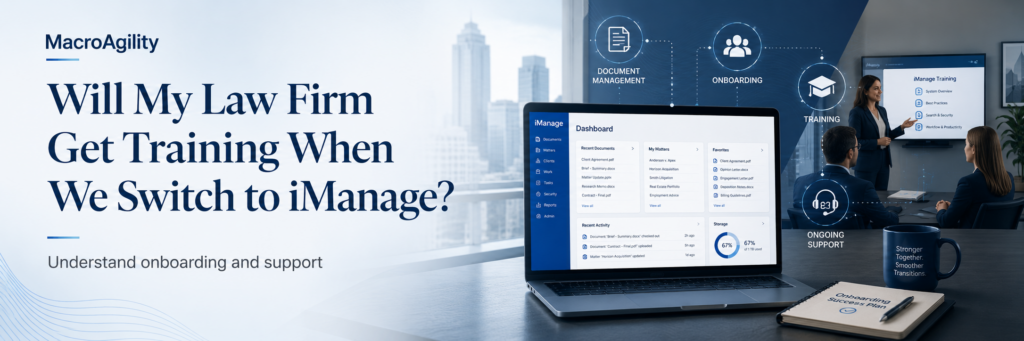
Will My Law Firm Get Training When We Switch to iManage?
Law firms considering a move to iManage frequently ask the same question: what happens to our people during the transition? The concern is understandable. Lawyers, legal assistants, and staff depend on reliable document management every day, and a poorly executed change can disrupt productivity, create confusion, and generate resistance across the firm.
The good news is that with a well-structured implementation plan, iManage training for law firms is built into the process from the start. Training, onboarding, and post-launch support are not optional extras. They are foundational elements of a successful transition, and they determine how quickly and confidently your team adapts.
Why Training Matters During an iManage Transition
Effective iManage onboarding directly influences how well the system takes hold within a firm. When users understand what the system does, how it fits their day-to-day work, and where to go when they have questions, adoption happens more naturally and more quickly.
Without a structured training approach, firms often face a predictable set of problems: a spike in support requests immediately after go-live, inconsistent filing practices, and lingering resistance from users who never felt comfortable with the system. These outcomes reduce the value of the investment and extend the time it takes to reach full productivity.
A structured legal document management system training program gives users the foundation they need before they encounter the system under pressure. It turns a technology change into a managed transition.
What iManage Training Should Include
Strong iManage onboarding goes well beyond a general system walkthrough. It should be grounded in the way the firm actually operates, not a generic demonstration of features.
A well-designed training program typically covers:
- Workflow mapping to align iManage with the firm’s real legal processes
- Role-based sessions tailored to lawyers, assistants, paralegals, IT staff, and records teams
- Administrative training covering system management, governance, and access controls
- User guides and reference materials that staff can consult after training ends
- Live support during go-live to address issues as they arise
- Post-launch reinforcement to sustain adoption over time
This structure ensures that training is relevant, practical, and appropriate for each group within the firm, rather than a one-size-fits-all approach that leaves important gaps.
Training for Lawyers and Legal Staff
Lawyers and legal staff need focused, concise training that connects directly to their daily responsibilities. This includes document creation, filing, searching, version management, and collaboration within iManage Work.
Effective sessions for legal professionals are built around familiar tasks. Lawyers benefit more from understanding how iManage fits into their existing workflows than from a comprehensive walkthrough of every available feature. Sessions that respect their time and start from real scenarios tend to produce better results.
Assistants and paralegals often require more detailed instruction. They handle document organization, filing standards, and administrative tasks that support the broader team. Their iManage adoption directly affects the quality and consistency of how documents are managed across the firm.
When law firm document management training is grounded in real tasks and realistic scenarios, resistance decreases and confidence grows.
Training for IT, Records, and Administration Teams
IT teams, records professionals, and firm administrators require a deeper level of iManage training than general users. Their understanding of the system affects everyone else’s experience.
Training for these groups should cover:
- System configuration, updates, and ongoing management
- Security settings and access control administration
- Records management, retention policies, and compliance requirements
- Troubleshooting processes and escalation procedures
These teams are responsible for the long-term health of the iManage environment. Thorough training enables them to support users effectively, maintain governance standards, and resolve issues before they become disruptions.
What Support Looks Like Before, During, and After Go-Live
Training is one component of a successful iManage implementation. Support across each phase of the transition is equally important.
Before go-live, firms benefit from planning guidance, user preparation, and pre-migration testing. This is the time to identify gaps in workflows, set expectations with staff, and establish training schedules.
During migration and launch, real-time support helps resolve issues as they surface. Having experienced resources available during this period can significantly reduce disruption and keep the transition on track.
After go-live, continued assistance helps reinforce what users learned during training and addresses questions that emerge as staff settle into the system. This phase is critical. Many firms underestimate the value of post-launch support and experience slower adoption as a result.
A transition that includes structured support at each stage is considerably more predictable than one that treats go-live as the finish line.
How MacroAgility Helps Law Firms Improve iManage Adoption
MacroAgility partners with law firms to plan and deliver structured iManage training and onboarding programs designed around the specific needs of each firm. The focus is on minimizing disruption while helping users build genuine competence and confidence in the system.
MacroAgility’s approach to iManage training is role-based, workflow-aligned, and informed by deep practical experience across a wide range of law firm environments. Sessions are designed to be relevant from the first interaction, not generic demonstrations that leave staff uncertain about how to apply what they have learned.
MacroAgility has developed some of the most effective iManage training programs available for law firms. These programs are built on real-world implementation experience and continuously refined through feedback from legal professionals. Firms consistently report strong satisfaction with the clarity, structure, and practical relevance of MacroAgility’s training sessions, along with high rates of user adoption following the transition.
This commitment to quality and usability translates to measurable outcomes: lower post-launch support volume, faster time to productivity, and stronger long-term use of iManage across the firm.
Beyond initial implementation, MacroAgility continues to support firms through workflow refinement, governance improvements, and additional training as needs evolve. iManage adoption is a long-term effort, and MacroAgility is structured to support it accordingly.
Final Thoughts
Your law firm should absolutely receive training when switching to iManage. In fact, training is one of the most consequential parts of the entire transition. When it begins early, is tailored to each role, and is reinforced by ongoing support, firms can minimize disruption and build the kind of adoption that makes the system genuinely valuable.
The difference between a transition that stalls and one that succeeds often comes down to how well the people using the system were prepared.
MacroAgility helps law firms plan, deliver, and sustain effective iManage training programs throughout the implementation journey. If your firm is planning a transition or looking to strengthen adoption of an existing iManage environment, MacroAgility is ready to help.
Contact MacroAgility to discuss training, onboarding, and support options tailored to your firm’s specific needs. www.macroagilityinc.com | info@macroagilityinc.com
Frequently Asked Questions
Do lawyers need formal training for iManage? Yes. Even attorneys who are comfortable with technology benefit from structured training that shows how iManage integrates with their daily workflows. Familiarity with document management systems in general does not replace training on how a specific firm’s iManage environment is configured and organized.
How long does iManage training typically take? Training timelines depend on firm size, complexity, and the scope of the implementation. Most programs include sessions in the weeks before go-live and structured support in the period following launch. MacroAgility works with each firm to develop a training schedule that fits its timeline and organizational needs.
Should training happen before or after migration? Training should begin before migration and continue after go-live. Pre-migration training prepares users and sets expectations. Post-launch reinforcement addresses the questions and habits that emerge once staff are working in the system under real conditions. Both phases are necessary for strong adoption.
Can MacroAgility help if iManage is already live at our firm? Yes. MacroAgility can assess your current iManage environment, identify adoption gaps, and deliver targeted training or workflow improvements to strengthen long-term use. Post-implementation support is a core part of what MacroAgility provides.

 Phone
Phone Email
Email